
Trew’s Law - Campaign for Policy Launch Event
The Case for Automatic Reviews of Imprisoned Police Officers’ Files for Miscarriages of Justice
Find out more about Trew's Law
TAKE ACTION NOW
10th September 2026
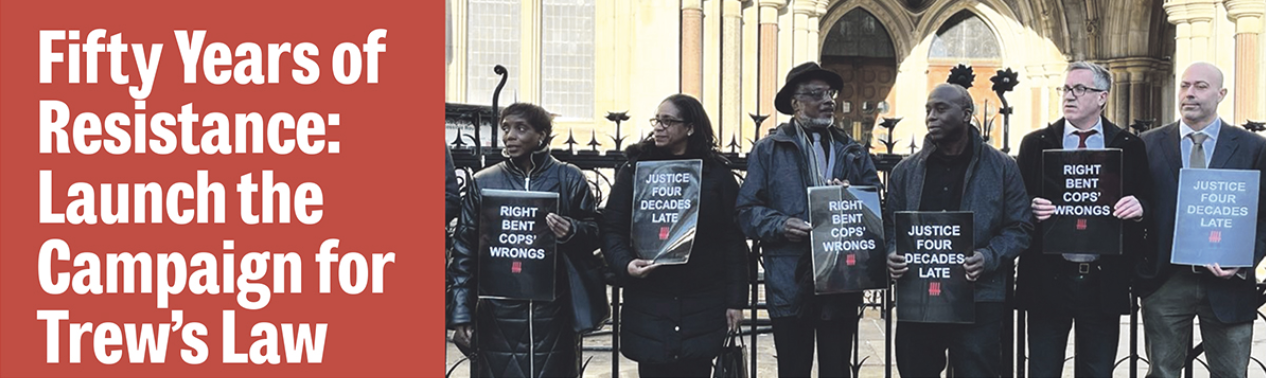
Photo Credit: Jess Hurd
On 10 September 2026, APPEAL launched the Trew’s Law campaign at Lambeth Town Hall. The campaign centres on a new policy report, Trew’s Law: The Case for Automatic Reviews of Imprisoned Police Officers’ Files for Miscarriages of Justice, based on research by York Law School, the Centre for Applied Human Rights at the University of York and APPEAL, and authored by Dr Joanna Gilmore, Dr Mattia Pinto and Mya.
Trew’s Law is a simple, practical safeguard. When a police officer is imprisoned for serious wrongdoing, an independent body should automatically examine the cases and convictions connected to that officer. The aim is to expose corruption, identify unsafe convictions and prevent innocent people from being left to uncover the truth — and fight alone for justice — years or even decades later.
The campaign takes its name from Winston Trew of the Oval Four, who was wrongfully convicted in 1972 after being framed by Detective Sergeant Derek Ridgewell, a racist and corrupt British Transport Police officer. Although Ridgewell was imprisoned in 1980 for conspiracy to steal goods in transit, there was no systematic review of the cases he had worked on. The Report reveals that since 2018, 13 convictions linked to Ridgewell have been quashed, affecting people who collectively spent 623 years living under wrongful convictions. This has now increased to 15 convictions. Some died before their names were cleared. Those are years that they, their families and their communities can never get back.
The launch took place at Lambeth Town Hall, a venue with deep significance for the campaign. Fifty years earlier, the Oval Four had gathered there for a public meeting (Winston Trew was still in prison) titled Cause for Concern: a rallying cry against the wrongful conviction, harassment and framing of Black men by corrupt police officers. Returning to the exact same venue underscored both how long survivors and families have been fighting, and how urgently the law still needs to change.
The event brought together people directly affected by wrongful convictions, legal experts, campaigners and elected representatives, including:
- Winston Trew, member of the Oval Four, author, campaigner, and the person after whom Trew’s Law is named.
- Jeffrey Campbell, son of Errol Campbell, who was wrongfully convicted in the Bricklayers Arms Depot case.
- Dr Mattia Pinto, Senior Lecturer at York Law School and the Centre for Applied Human Rights, and co-author of the policy report.
- Kim Johnson MP, Labour MP for Liverpool Riverside and Chair of the APPG on Miscarriages of Justice.
- Cllr Jonathan Bartley, councillor in the London Borough of Lambeth and long-time campaigner on social justice and police accountability.
- Matt Foot, APPEAL’s Co-director and solicitor working with some of the families of those wrongfully convicted by Ridgewell.
- Mya, Racial Justice Researcher at APPEAL and co-author of the Trew’s Law policy report.
Hearing Winston Trew describe his long fight for justice, and Jeffrey Campbell speak about the lasting impact of his father’s imprisonment, made clear that wrongful convictions do not only harm the people sent to prison. They reverberate through families, communities and generations.
The case for reform is urgent and contemporary. The research behind Trew’s Law identified at least 64 serving or former police officers who were imprisoned between 2023 and 2026 for offences including corruption, dishonesty, abuse of position and violent or sexual offences. Yet there is still no legal requirement for authorities to identify and review convictions connected to those officers. Freedom of Information requests also exposed a troubling gap: there is no central system recording when police officers are imprisoned, whether their previous cases are reviewed, or what happens as a result.
As Winston Trew has said, justice should not depend on luck, or on victims fighting for decades to uncover police wrongdoing. Trew’s Law would place responsibility where it belongs: with the state.
Too many lives have been ruined, and too much time has been lost, because the justice system failed to act when police corruption was exposed. Trew’s Law offers a practical and necessary step towards preventing future miscarriages of justice. It would help ensure that stories like those of Winston Trew, Errol Campbell and many others are not repeated — and that when the state causes harm, it has a duty to put things right.
Add your name now - Sign the petition calling for the Justice Secretary to enact Trew’s Law.
IN THE MEDIA

Trew’s Law – Press Release
APPEAL and the University of York Launch Trew’s Law APPEAL and the University of York Launch Trew’s Law: The Case…
Justice Committee, Courts and Tribunals Bill, June 2026
Justice Commitee Courts and Tribunals Bills APPEAL /// June 2026 We welcome the Justice Committee’s finding that the automatic right…

Media Enquiries
Subscribe to Newsletter
Get Legal Help
Complaints Policy
Privacy and Cookie Policy
72-75 Red Lion Street (6th Floor)
London, WC1R 4NA
07735 434268
mail@appeal.org.uk
APPEAL is the working name of the Centre for Criminal Appeals, a Charitable Company Limited By Guarantee and a law practice authorised and regulated by the Solicitors Regulation Authority.
Registered Charity Number: 1144162 | SRA Authorisation Number: 621184 | Company Number: 07556168